
Patrick O'Shaughnessy
Podcaster. Allocator. Professional learner. No goals, just compounding.

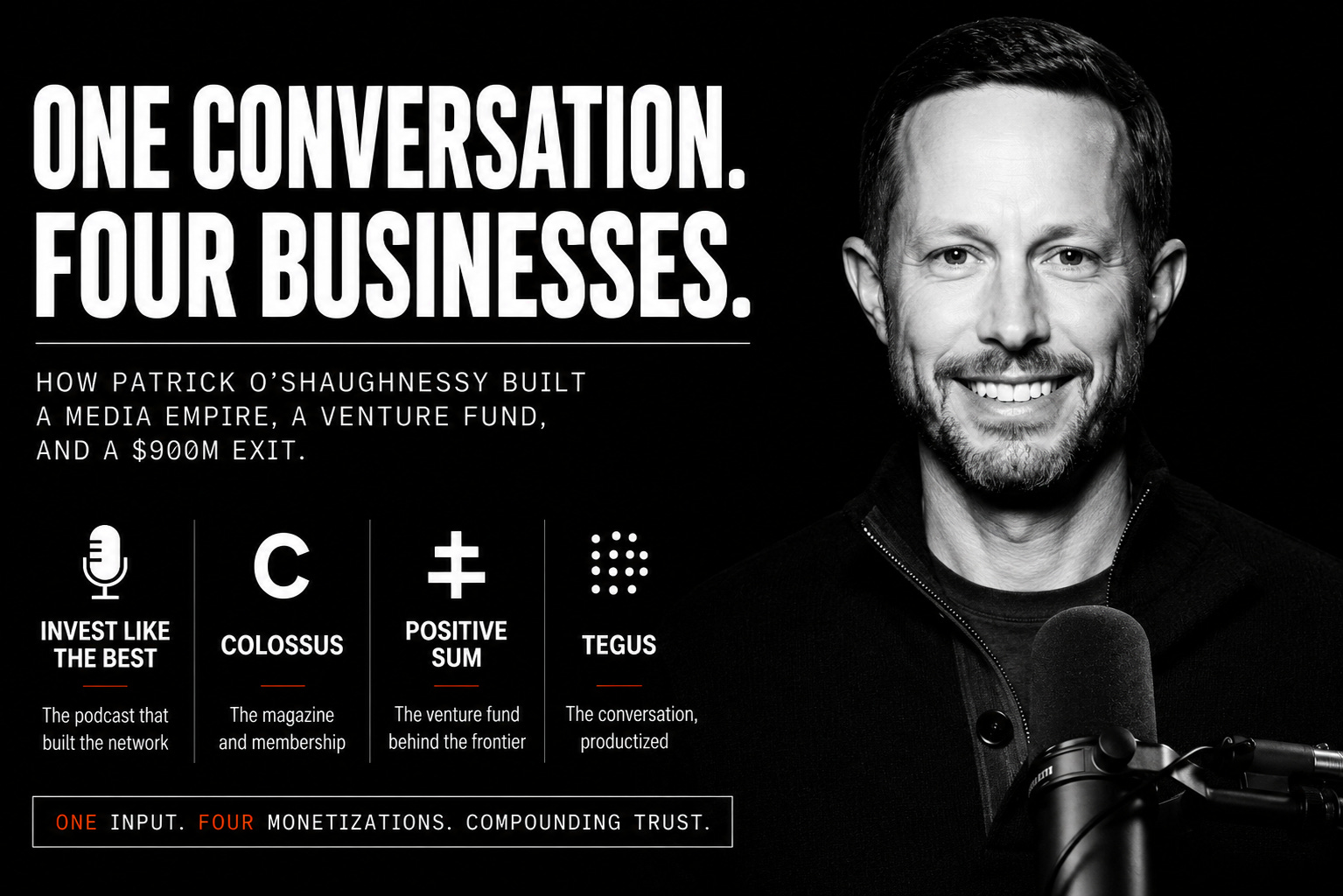
Most people know Patrick as “the Invest Like the Best guy.”
That’s the trap. The podcast isn’t the business. The podcast is the engine — and almost nobody copies the actual machine underneath it.
He inherited a famous name in finance and a microphone. He turned them into a media network, a venture fund, and a nine-figure exit, all running on a single repeatable act: sitting across from a brilliant person and asking how they really think.
Here’s the breakdown.
1. Origins: The Name He Had to Earn
Son of James O’Shaughnessy, the quant legend behind What Works on Wall Street
B.A. in philosophy from Notre Dame, not finance, not CS
Walked into his father’s firm (OSAM) as an intern in 2008
Spent roughly seven years entering and analyzing raw market data before anyone handed him anything
Earned his CFA in 2014, wrote Millennial Money the same era
Took the CEO seat in 2018
The grunt work is the moat. He’s said the data years gave him deep respect for how hard it is to beat the market.
A warm name gets you in the room. It does not get you respected in the room. He did the unglamorous reps first.
2. 2016: The Podcast That Was Never Meant to Be a Business
He launched Invest Like the Best for the most boring reason possible: he wanted to learn.
Used the show as an excuse to sit with the best investors and operators alive
No monetization plan, no business model, no “content strategy”
The byproduct was the rarest asset in business: a trust surface with the people who control capital and build the future
His real skill isn’t interviewing. It’s collecting dots before he needs them. He borrows restaurateur Danny Meyer’s line:
“Always be collecting dots, so that you can always be connecting dots.”
By the time he interviews someone, he’s usually been preparing for years without trying. He doesn’t prepare for the conversation. The conversation is what his whole life is already pointed at.
3. The Sale: Offloading the Grind
This is the move 99% of operators get wrong.
OSAM’s growth engine was a custom-indexing platform called Canvas — fast-growing, but capital-intensive, regulated, headcount-heavy. The operational business. Linear.
So in 2021 he sold OSAM to Franklin Templeton, a $1.5T asset manager.
Canvas was roughly $2B of OSAM’s ~$6.5B in AUM at the time
He handed the linear machine to a giant that could run it better
He kept the businesses that compound without an army
Lesson rarely said out loud: your cash-flow business and your wealth business are usually not the same business. Sell the wheel that needs more hamsters.
4. The Productized Conversation
The masterstroke.
Invest Like the Best is, mechanically, an expert interview — one sharp mind extracting signal from another.
There is a company that does exactly that, at industrial scale, and sells it to every serious investor on earth: Tegus (expert-call transcripts and research).
He invested $20M into Tegus through his fund, Positive Sum
Partnered with it through his media network to drive distribution
Watched it exit to AlphaSense for ~$930M in 2024
He found the institutional version of his own daily workflow, then owned a piece of it.
The thing you do by hand every day is a clue. Somewhere there’s a fundable, exit-able version of it. Own that before everyone else sees it.
5. Attention to Ownership: Positive Sum
Most podcasters monetize with ads. Ads are rent. Patrick wanted equity.
In 2020 he co-founded Positive Sum with Sam Cates on a brutal, simple edge:
Founders let him onto the cap table because he brings distribution and credibility no plain check can match.
~23 investments, heavily tilted toward frontier tech
Portfolio includes Etched, Cognition, Physical Intelligence, Vanta, ID.me, Base Power
The podcast doesn’t promote the fund. The podcast is the fund’s moat — the source of deal flow, founder access, and the right to win oversubscribed rounds.
6. The Colossus Machine: One Unit, Four Monetizations
Step back and the empire collapses into one input:
A high-signal conversation with a brilliant operator.
He sells that single unit four different ways:
As a podcast network — Invest Like the Best, Founders, Business Breakdowns (audience + trust)
As a magazine and membership — Colossus Review, direct subscription revenue
As a company — Tegus, the conversation productized
As a cap table — Positive Sum, the conversation converted to equity
His own framing now: media and investing are the same activity. Both are just finding the most interesting people early and building a relationship before everyone else does.
If your businesses each need a different input, you don’t have a flywheel. You have a to-do list pretending to be a strategy.
7. The Philosophy: Growth Without Goals
The most-read thing he ever wrote is an essay called Growth Without Goals. The thesis is the opposite of hustle culture:
“I have no goals. I’m not a goals person.”
He rejects the Big Hairy Audacious Goal entirely
He believes a distant singular goal crowds out serendipity and discovery along the way
Instead: commit to a daily practice and protect it with your life
His loop is four words — Learn, Build, Share, Repeat — run for a decade
He won’t stick around anything boring. That allergy, not a five-year plan, is what’s routed him into every good thing he’s built.
8. Daily Life (reconstructed 2026 stack)
Built from his documented habits, not a leaked calendar. Patrick guards the specifics, but the inputs are well established.
Morning — Reads. Relentlessly. He gets through roughly 100 books a year and runs a book club off the back of it. The reading is the prep for everything else.
Midday — Records. The core ritual is the conversation itself: prepping by osmosis, then sitting down with a founder, investor, or scientist and going deep for 60 to 90 minutes.
Afternoon — Connects dots. Routing ideas between people, sourcing Positive Sum deals out of podcast relationships, shaping Colossus editorial, recruiting talent by their public output.
Evening — NYC family man. Married, kids. Low-noise. The ambition runs on what he calls “clean fuel” — curiosity and craft, not resentment or status.
Operating principle: no rigid schedule, one non-negotiable daily practice. The structure is the habit, not the clock.
Quirk Detail Professional learner Treats reading ~100 books/yr as the job, not a hobby Hires by output Recruited editors and researchers off their public work, not resumes Anti-goal Wrote the essay; refuses BHAGs on principle Boredom allergy Will not stay attached to anything that stops being interesting Relationship compounder “Relationships run the world” is the actual strategy Print contrarian Launched a physical magazine in 2025 while everyone chased video
9. The Current Vibe (2026)
Where his attention sits right now tells you exactly what he’s betting on:
All-in on the AI supercycle as subject matter. Recent Invest Like the Best guests include Anthropic’s CFO, Gavin Baker on AI infrastructure, and Dylan Patel on the economics of compute.
Positive Sum is tilted at the frontier and the picks-and-shovels — AI chips (Etched), agents (Cognition), robotics (Physical Intelligence), and even the power grid behind it all (Base Power, Series C, late 2025).
The contrarian print bet. While the entire creator economy chased short-form video, he doubled down on a quarterly print magazine and a paid membership, betting that scarcity and physical objects cut through the slop.
The signal: he’s not chasing the AI narrative as a trader. He’s positioning to own infrastructure and attention around it, the same way he always has.
TL;DR — Patrick O’Shaughnessy Is...
The operator who proved media and capital allocation are the same game
A quiet compounder who sold the grind and kept the leverage
Building one atomic unit, a great conversation, and monetizing it four ways
Running on curiosity, relationships, and a flat refusal to set goals
He didn’t get rich because he’s a great interviewer. He got rich because he understood, earlier than almost anyone, that trusted attention from people who matter is the scarcest asset there is, and he built three machines to turn it into ownership.
Your Move This Week
Find the one thing you already do that builds trust and relationships. Then answer the only question that matters:
Am I monetizing this once, or four times?
Most operators are leaving three of the four on the table.